
How Much Does Epoxy Floor Coating Cost?
Poll a few neighbors on epoxy floor prices and the numbers can sit miles apart, mostly because each person priced a different amount of work. This page unpacks the parts of a professional estimate, how each factor tilts the total, and what belongs in a thorough written proposal.

The Short Answer
As a budgeting yardstick, professionally installed epoxy floor coatings commonly come in at $6–$10 per square foot. Using $8 as the midpoint puts an ordinary two-car garage at roughly $3,200–$4,000. Your own number depends on floor size, how much preparation the concrete needs and which coating system suits the space, and none of that is reliable until someone evaluates the floor in person.
What Affects the Cost?
Five factors account for most of the spread between one epoxy proposal and another.
01
Floor Size
Square footage drives material and labor upward. Yet some costs barely budge with size, such as hauling equipment, setup and mobilization. A large slab absorbs those fixed costs so they become a smaller slice of the total, while on a small floor they loom larger. Accurate tape-measure numbers anchor any estimate.
02
Concrete Condition
Slabs with oil saturation, leftover sealers, widespread cracking or a crumbling surface all need extra prep before coating can start. Sound concrete with no sealer history reaches the needed profile with a lot less effort.
03
Surface Preparation
Grinding roughens the concrete and creates the tooth a coating grips. How much is needed varies: hard-troweled finishes, damage and earlier coatings all expand the work. Budgeting honestly for prep is how an estimate reflects the real price of a floor built to perform.
04
Coating System
One coat is the cheapest materials scenario. Layered builds stack primer, a high-build base, decorative flake and a urethane or polyaspartic topcoat, and that stack consumes substantially more product. Slab condition and what the room demands should set the build, not a package picked by default.
05
Decorative Finish
Solid color is the simplest finish to apply and the least costly decorative option. Flake takes more material and labor and gives a speckled, textured look. Metallic effects take a specialist touch, and they sit at the priciest end of the decorative menu.
What Are You Really Paying For?
Our step-by-step look at the installation process lays out what happens at every stage of a professional coating job, and why.
An estimate covers the entire job: labor for preparation and application, grinding equipment along with its diamond tooling, commercial-grade materials and the experience needed to pick the right system for that particular floor. Materials are only one piece of the total.
When a single quote comes in well under the rest, ask what has been left off. A shallower grind, a thinner build or ignored cracks make for a smaller project, not a bargain on an identical one. Line-by-line comparison reveals what each proposal includes.
Trimming prep, coats or repairs reduces the price because the project itself gets smaller, and sooner or later the floor shows the difference.
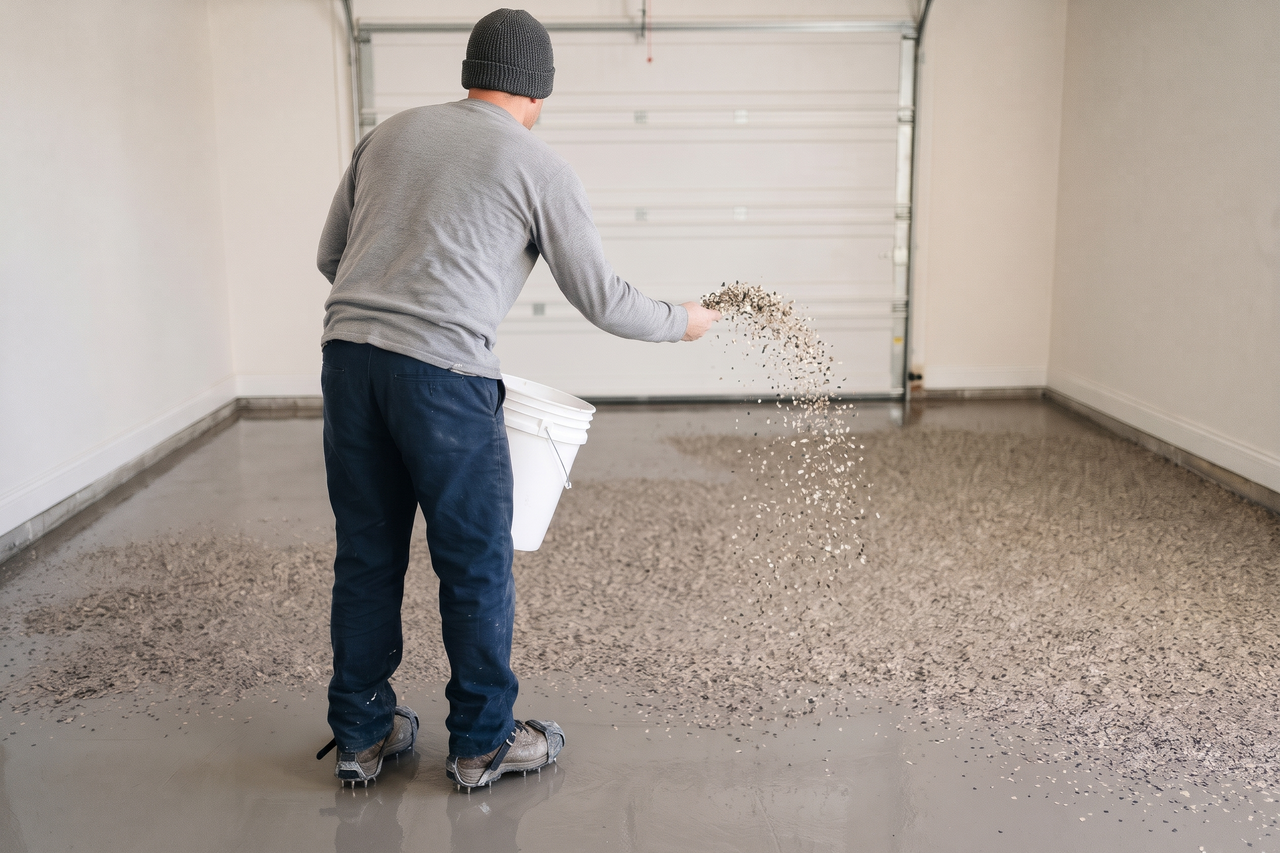
How Much Does a Garage Floor Cost?
Here are four familiar garage sizes priced at the $8 planning figure, strictly as rough budget guides.
| Garage | Approx. Area | Budget Planning Number |
|---|---|---|
| Compact one-car | 250 sq ft | $2,000 |
| Everyday two-car | 400 sq ft | $3,200 |
| Extra-deep two-car | 500 sq ft | $4,000 |
| Three-stall | 750 sq ft | $6,000 |
Method: each row multiplies square footage by $8, a planning rate that sits inside the usual $6–$10 band for professional work. These are budgeting guides, not quotes. Real pricing turns on concrete condition, prep needs and which coating system is selected; nobody can pin it down before an in-person evaluation of the floor.
Is It Worth the Cost?
Picture the routine of a garage floor: tires crossing it, parked cars dripping on it, tools dropped on it and gear dragged over a surface nobody designed to stay handsome. Bare concrete takes every bit of that in.
Unsealed concrete is porous by nature. Liquids seep in and stain, dullness and blotches spread with use, and mechanical stress grinds the surface down. Put a coating on concrete that skipped proper profiling and the bond may be unreliable; lifting or peeling can follow, leaving the owner to pay for that floor a second time.
Picked for how the space is really used, a coating keeps liquids at the surface far better than bare concrete can, so cleanup is easy. The payoff is biggest in garages, workshops and utility rooms, since appearance and easy cleaning rank high in those spaces.
What Should Be Included in Your Quote?
A solid proposal describes the whole project, not merely the product going down. Read any written proposal against this list and make sure each item appears:
- Slab assessment — moisture readings plus a hands-on check of the concrete before planning starts
- Mechanical profiling — the slab roughened by diamond grinding or shot blasting so the coating has tooth to grab
- Defect repair for cracks and spalls, done on bare concrete ahead of coating
- Primer choice tied to moisture readings and the absorbency of the slab
- Base layer and flake — color coat and decorative broadcast installed per the selected system
- Topcoat rated for the wear and conditions expected in the space
- Cleanup of grinding dust and prep debris, with waste hauled away
- Cure guidance explaining which uses are fine at each stage once the last coat is down
Anything on this list that a written proposal leaves out is worth raising with the contractor before you sign.
Frequently Asked Questions
Q: What makes epoxy estimates differ so widely from one contractor to the next?
Scope explains most of it. Thinner prep, fewer coats or no budget for crack repair mean less work is being priced, so the lower number reflects a smaller job rather than greater efficiency. Put proposals next to each other and go line by line to see what each really contains.
Q: Do big floors come out cheaper per square foot?
Often, yes. Mobilization, meaning equipment transport and site setup, costs about the same whether the floor is big or small, so a large slab divides it among more square feet. On a small floor it claims a bigger share of the total.
Q: How useful is the $6–$10 range for early budgeting?
As a first step, yes. Plugging the $8 midpoint into the garage table above yields a rough figure driven by size alone. The range knows nothing about the condition of your slab, the prep involved or the system that fits, so a number worth relying on has to come from an in-person look at the floor.
Q: How much does the condition of the concrete affect the price?
In some cases, considerably. Heavy repairs, stripping a failed coating or patching large areas pile labor and material onto the prep stage. On a slab with serious problems, prep can represent a large part of the estimate.
Q: What costs could land outside the flooring proposal?
Owners usually handle clearing out cars, equipment and anything stored in the space beforehand. Structural slab problems, drainage corrections and repairs that go beyond the coating scope generally fall outside a standard flooring proposal.
Q: What does a higher estimate usually signal?
Often a higher number signals a more complete scope: extra coats, higher-grade materials or a system engineered for tougher conditions. A bigger figure proves nothing by itself; ask what it covers and why the proposed system suits your floor. Straight, detailed answers tend to indicate a recommendation that was carefully reasoned.
Ready to Get a Real Number for Your Floor?
Serving Spencer, IA and surrounding areas. Describe what your floor is up against and request a customized quote built on what it actually requires.